Japan, Trip Two, Mountains, the Inland Sea & a White Mountain in the Distance
The return to Japan, and almost the opposite trip. Two weeks running for the mountains and the sea: peak-autumn Nikko, a clean Fuji from the bullet train, the floating torii of Miyajima, a rental car driven across the bridges and islands of the Inland Sea, a white castle, a whirlpool strait, and onsen at Hakone. A long, ambitious loop, and the trip where we both got sick on the road and kept going anyway.
Two years after my first Japan, we went back, and did almost the opposite trip. Where Trip One was the Tokyo-and-Kyoto first-timer’s loop, this one ran for the mountains and the sea: peak-autumn Nikko, a clean Fuji from the bullet train, the floating shrine at Miyajima, a rental car driven across the bridges and islands of the Inland Sea, a white castle, a whirlpool strait, and hot springs at Hakone. Same country, a completely different journey, and the one where we both got sick halfway through and pushed on anyway.
Getting there: ANA, Narita, and the Skyliner
We always fly ANA, and we always book the slightly-more-affordable step up that isn’t quite business and isn’t quite first, ANA’s premium economy, the comfortable in-between. The difference this time was the airport: we flew into Narita instead of Haneda, where we’d landed on our first trip. I still prefer Haneda. Narita is a bit of a pain, you have to buy a separate train ticket into the city, either the Narita Express or the Keisei Skyliner, and then find the right terminal counter, feed in cash, get your ticket, and time the whole thing to the schedule. We went with the Skyliner. It works; it’s just one more puzzle at the end of a very long day.
Odaiba, the opposite shore
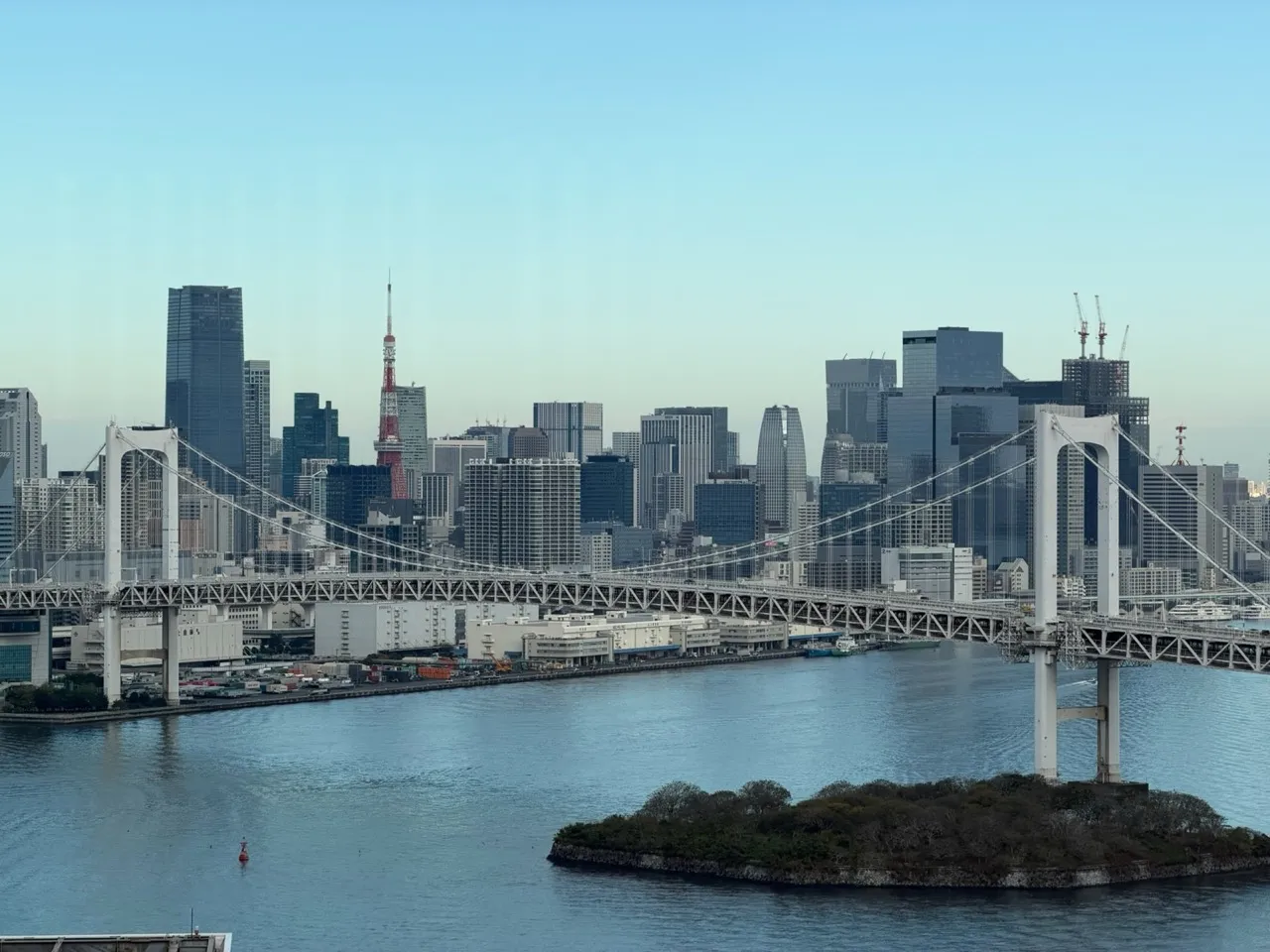
We based ourselves in Odaiba this time, the futuristic man-made island out in Tokyo Bay. On the first trip we’d stayed (and looked) from the Tokyo side; this time we were on the Odaiba side, the exact reverse view, in a really good hotel with a window straight onto the Rainbow Bridge and the skyline beyond.
The view from the bay: Rainbow Bridge with Tokyo Tower and the skyline behind it, from Odaiba.
Even though it was late by the time we settled in, we couldn’t help ourselves, we got right back on the train and crossed over to our favorite sushi place, Sushiro, in Yurakucho. It’s funny how many times we’ve now been to that exact spot, and we love it every single time. We wandered a little afterward, then went back and crashed.
The hotel breakfast deserves its own paragraph, and if Nick were telling this story, it’d be his favorite part. It was a half-buffet, half-order-to-the-table setup, where they’d ask which main you wanted from a short list. Nick got a French toast that came out thick and gorgeous (he said it was great), and I got eggs and bacon that were honestly phenomenal. But the moment Nick won’t let me live down: when the server asked how I wanted my eggs, I said scrambled, and then asked if I could get them with a little cheddar cheese. She replied, very politely, with something to the effect of “no, we don’t do that here.” Nick thinks me trying to order scrambled eggs with cheese in Japan, and getting a flat we don’t do that, is one of the funniest things that happened all trip. We loved that breakfast enough to have it twice.
A day we didn’t plan: Harry Potter, Nintendo, and a CD I’d hunted for years
Our first full day had no plan at all, so we went looking, and discovered we could get tickets to the Warner Bros. Studio Tour Tokyo, The Making of Harry Potter, out in Nerima. Harry Potter is a complicated thing to love these days, given the author’s anti-trans politics, but for us it’s tied up in growing up with it, and we wanted to stand inside the immersive world for a while. We went through every single experience, saw all the props and set pieces, and the giant Hogwarts castle model at the end was genuinely incredible. We ate there too, I think I had bangers and mash or some kind of chicken, the gift-shop version of traditional English food, cheerfully passing itself off as traditional English food.
Later we hit the Nintendo store in Shinjuku, and then Tower Records. For years I’ve been quietly hunting for a CD by my favorite band from when I was a teenager: Malice Mizer. And I found one, their 1998 album Merveilles (their most successful record, the one with Gackt). It’s still shrink-wrapped, and I’ve left it that way; it’s now one of my most prized possessions.
Up into the mountains: Nikko
A special limited-express train carried us from Tokyo up to Nikko, and the timing was perfect, mid-November is exactly when the koyo, the autumn color, peaks here, and the maples were blazing.
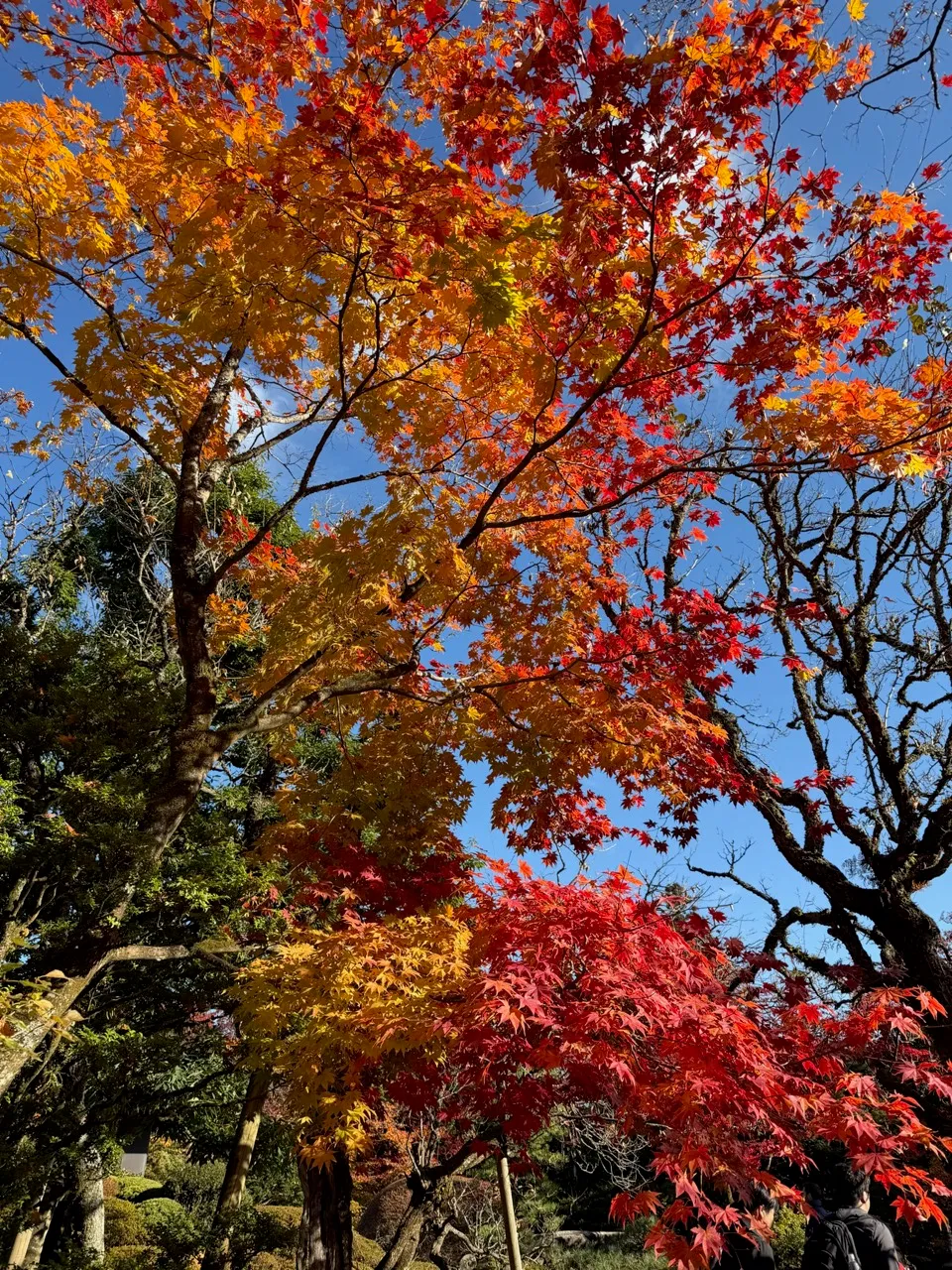 Peak foliage at Nikko, reds, oranges, and golds against a cloudless November sky.
Here’s a thing I never understood about Nikko until I went: when you look at it on a map, a lake, some falls, you don’t realize you’re going up into the mountains. In my head, I always pictured arriving at the station up high and riding a bus down into a valley where the lake sat. The reality is the opposite: you climb. We took a bus up winding, switchbacking mountain roads to our hotel near the lake, then back down the next morning to the temples, then up again, then down again on the day we left, and somewhere in all that climbing you develop a real appreciation for the engineering and skill behind building roads up Japanese mountains.
We stayed at Hatago Nagomi, right by Lake Chuzenji in Oku-Nikko, and it was amazing, the rooms are just okay, honestly, but the service is fantastic, the staff impossibly warm. The food was unique and a little mysterious; we didn’t know what we were eating half the time at breakfast or dinner, but we did our best to enjoy some very, very traditional Japanese cooking, kaiseki courses of local mountain produce, things like yuba (Nikko’s famous tofu skin), sukiyaki, hot yudofu tofu, and grilled river fish. It was cold enough already that we didn’t do much on the lake besides admire it, including Kegon Falls, the nearly 100-meter plunge fed by Lake Chuzenji, ranked among Japan’s three great waterfalls.
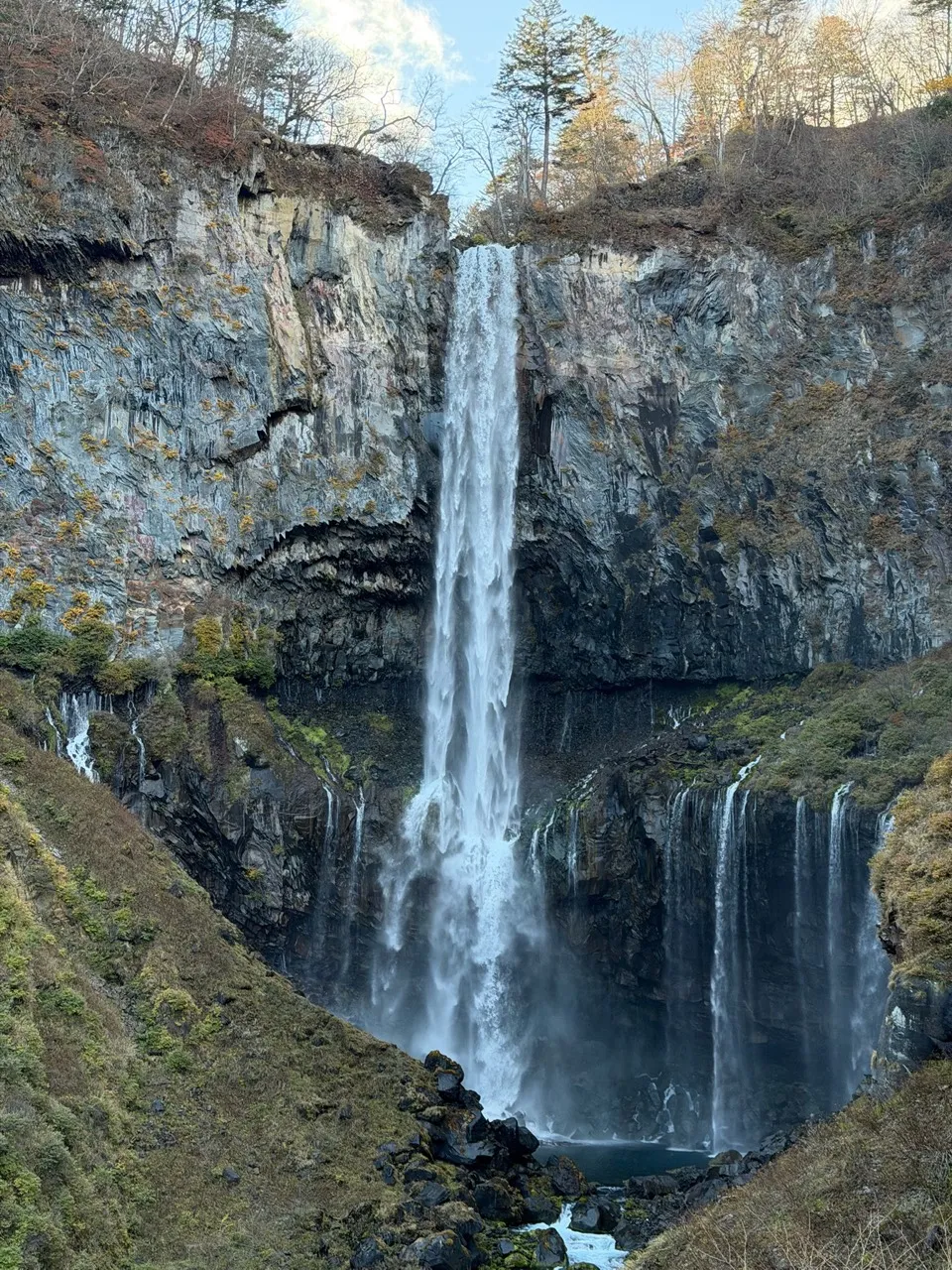 Kegon Falls dropping nearly 100 meters off the Lake Chuzenji highlands.
We did basically everything you’d want to do up there, with one miss: the Akechidaira Ropeway. We didn’t understand it only ran at certain times, and the one window we could’ve caught it, we didn’t realize in time. Lesson filed away.
The next day we came down to the Rinnoji and Toshogu temple area in Nikko town, Toshogu being the ornate, gold-leafed, UNESCO-listed mausoleum of Tokugawa Ieyasu, the shogun who founded the Edo era. The fall leaves down there were stunning, and we got some of our best pictures of the whole trip while exploring every shrine and temple we could find. We’d had a fantastic lunch the first day at Pension Friendly, I honestly can’t remember exactly what I ordered, but I’m fairly sure it was the beef steak bowl (特選牛ステーキ丼), and it was so good. On the second day we kept it humble and ate conbini food behind the Lawson Nikko Toshogu store, which was its own kind of fun. Dinner and breakfast were always back at the ryokan.
A darker note: two disappearances
At Nikko station we kept seeing information pamphlets about Tiphaine Véron, and her story stopped us. She was a 36-year-old French tourist who came to Nikko alone in July 2018 and vanished; she was last seen at breakfast in her hotel and was never found. What unsettled us most was learning that French authorities have pursued it as a possible kidnapping while Japan never even opened a criminal investigation. It shook us, the idea that people simply disappear, and it reminded us of the Lucie Blackman case, a young British woman who went missing in Tokyo in 2000 (we’d recently watched the Netflix documentary about it). Standing there in such a beautiful place, it was a quiet, necessary reminder: Japan is wonderful, and Japan also has problems, like everywhere else in the world.
West by bullet train: Fuji, and Hiroshima
On the third day we took the train back to Tokyo and then rode the Shinkansen all the way down to Hiroshima, a real express push west. The bullet train handed us the prize every visitor hopes for and few get: a clean, snow-capped Mount Fuji, caught through the Tokaido corridor.
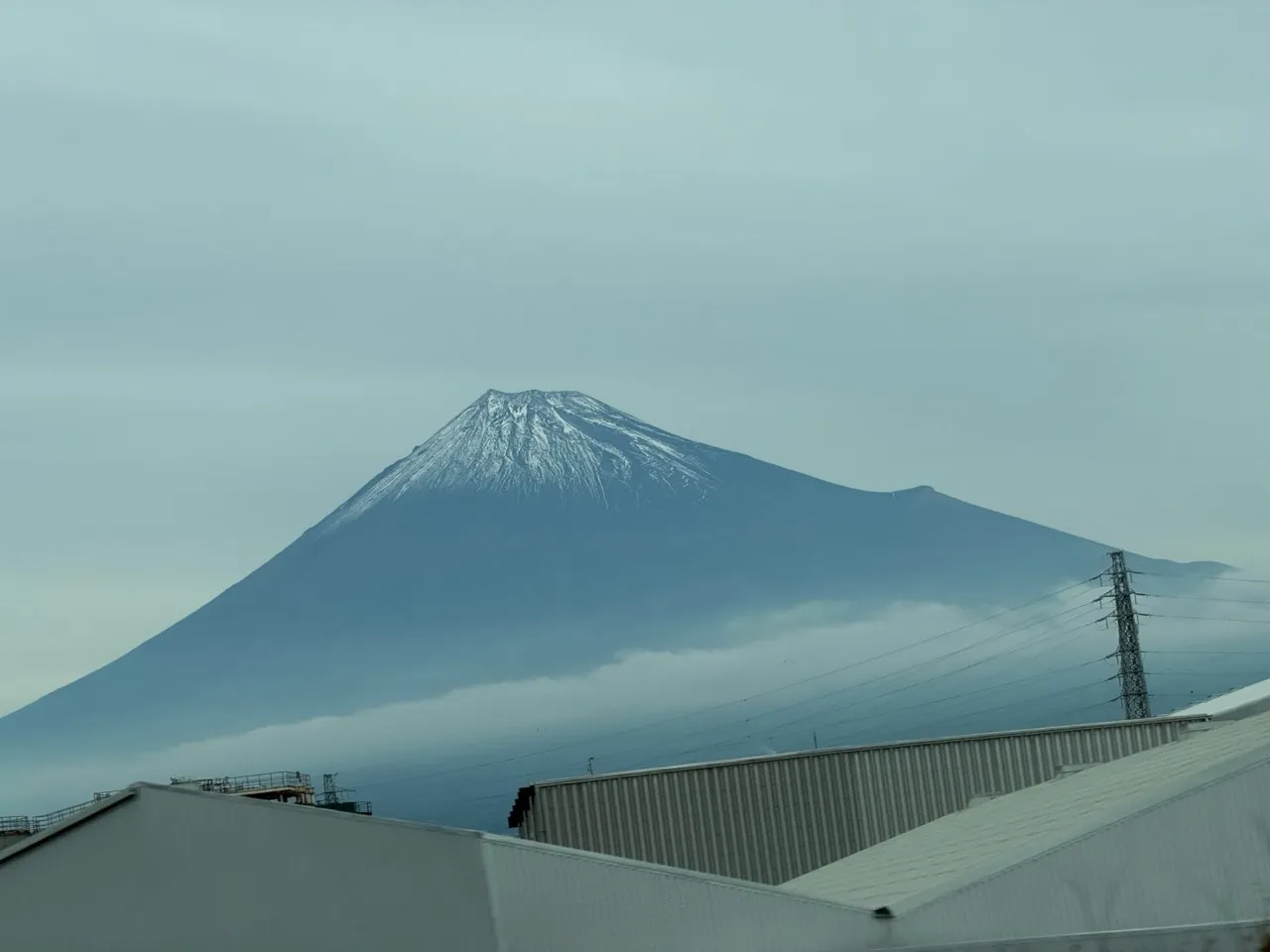 Fuji, snow on the summit, framed by warehouses and power lines, the unmistakable shot-from-the-Shinkansen view.
Our Hiroshima hotel turned out to be a surprisingly historic one: the Grand Prince Hotel Hiroshima, which hosted the G7 summit in May 2023, the one where President Biden and the other leaders met in the city that survived the atomic bomb. The lobby is a huge atrium with a big water feature, and they had all their Christmas decorations up. (So, possibly, we slept somewhere a world leader once did, a funny thing to think about while jet-lagged.) Our first night there we tried a kaiten sushi chain we’d never been to before, Hamazushi, and it was fantastic, we genuinely love conveyor-belt sushi, and this was a great new entry in the rotation.
Miyajima: the floating gate, and the dark cave
The next morning we took the boat over to Miyajima to see the great vermillion torii of Itsukushima Shrine, the gate that famously stands in the sea. We timed it lucky: the tide hadn’t come in yet, so the water hadn’t flooded around it, and we got to walk right out and touch it with our own hands.
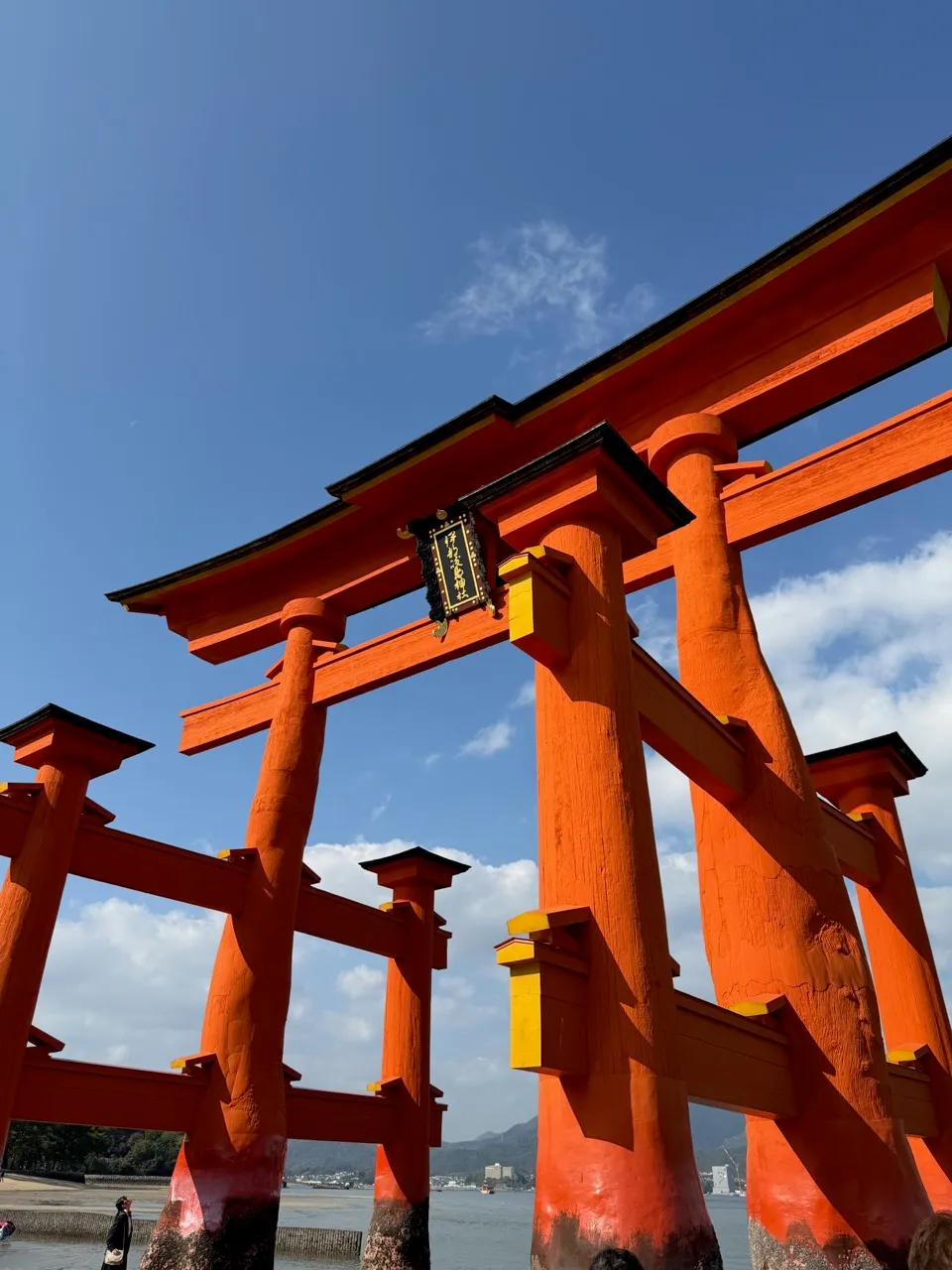 The floating torii of Itsukushima Shrine, Miyajima, out at low tide, close enough to touch.
We were smart about one thing: we rode the ropeway up Mount Misen almost first, which turned out to be a lucky call, because the shuttle bus to the ropeway base doesn’t always run all the way, especially once it gets busy. And it did get busy: when we came back down there was a huge line that simply hadn’t existed when we went up.
The most memorable thing on the island was unexpected. While exploring, we came across a temple, Daisho-in, where you could go underneath a hall, push past some drapes, and step into a passage that was completely dark. You couldn’t see a thing; you had to feel your way along, and I just held Nicholas’s hand and guided us through. This is the Henjokutsu cave: beneath the floor are panels tied to all 88 temples of the Shikoku pilgrimage, so walking the dark circuit is said to earn the same blessing as completing that multi-day journey on foot. The darkness is the point, a symbolic passage about letting go, a kind of death-and-rebirth toward enlightenment. Doing it blind, hand in hand, was something neither of us will forget.
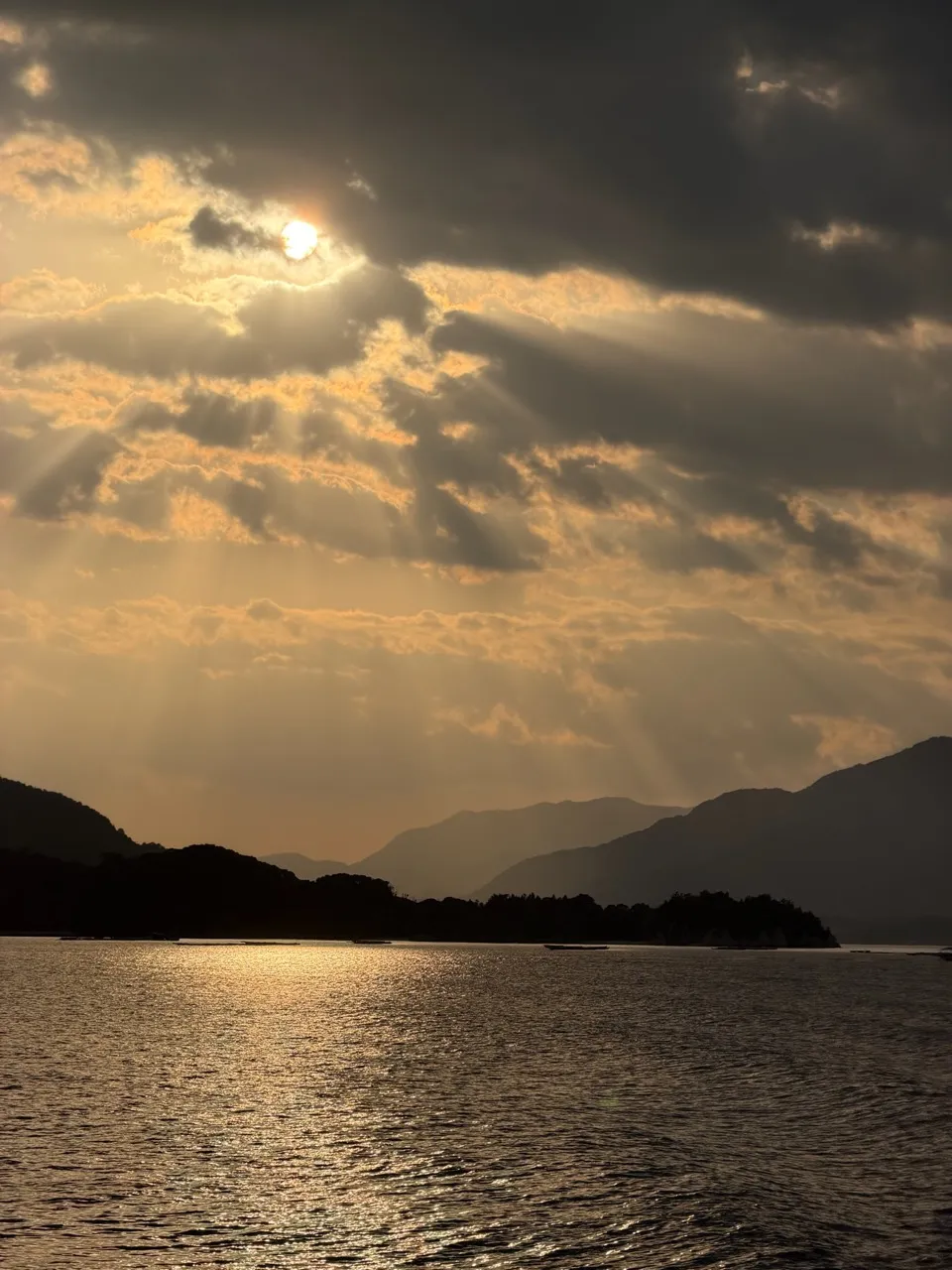 Crepuscular light over the islands of the Seto Inland Sea, from Miyajima.
The one disappointment: Miyajima’s famous five-storied pagoda was completely wrapped in construction scaffolding, one of the things I’d most wanted to see, gone behind tarps. Lesson learned: if there’s a specific landmark you’re after, check it isn’t mid-restoration first. We ate streetside, food-stall style, I think a chicken or noodle bowl, and by the time we left, the tide had fully come in and the torii was once again standing in the water. We caught the ferry back.
The Peace Museum
We were on a tight clock, but the one thing we would not skip was the Hiroshima Peace Memorial Museum. We went late in the afternoon and into the evening, sobering, essential, the kind of place you’re quiet leaving. Dinner that night was, of all things, McDonald’s. Some days are like that.
The drive: a rental car across the Inland Sea
The next leg is the one this trip will be remembered for. We took a train to Shin-Onomichi Station and rented a car, which meant first sorting out an International Driving Permit. Driving in Japan, on the opposite side of the road and the opposite side of the car, had genuinely been on my bucket list. I was nervous, but it was something I wanted to experience. It took me five or ten minutes to recalibrate my whole sense of the road, and after that we were completely fine.
Most people cross the Inland Sea here by cycling the famous Shimanami Kaidō; we drove it, which gave us the freedom to wander on our own clock. We stopped at a temple in Onomichi, then drove to the showpiece: Kosanji Temple on the island of Ikuchijima.
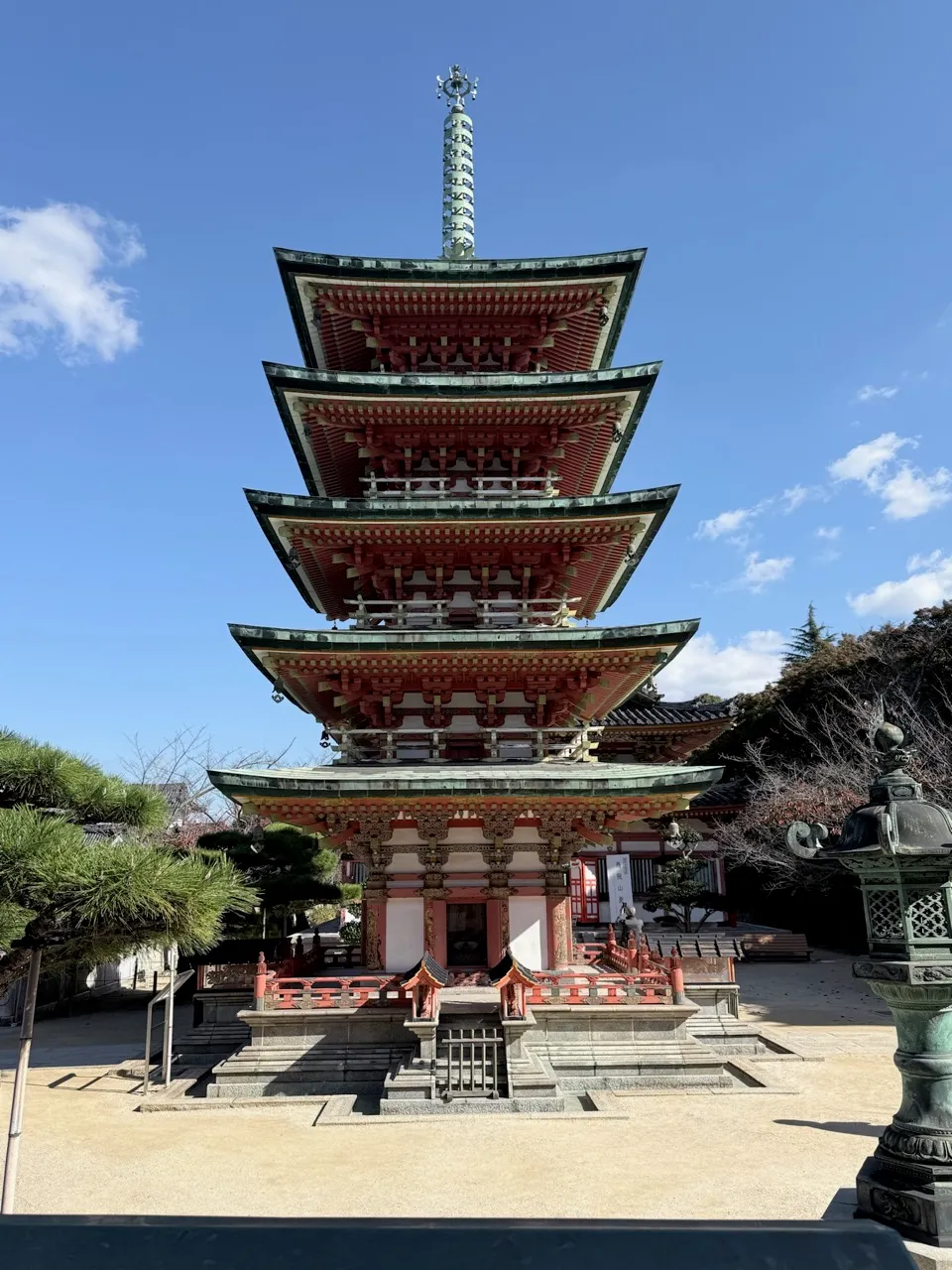 The five-story pagoda at Kōsanji Temple, on the island of Ikuchijima.
Kosanji is gloriously over the top, vivid, brilliant colors everywhere, a cave you walk through, giant statues, and up top the surreal Miraishin no Oka, a whole hill of carved white marble. I’d recommend it to anyone.
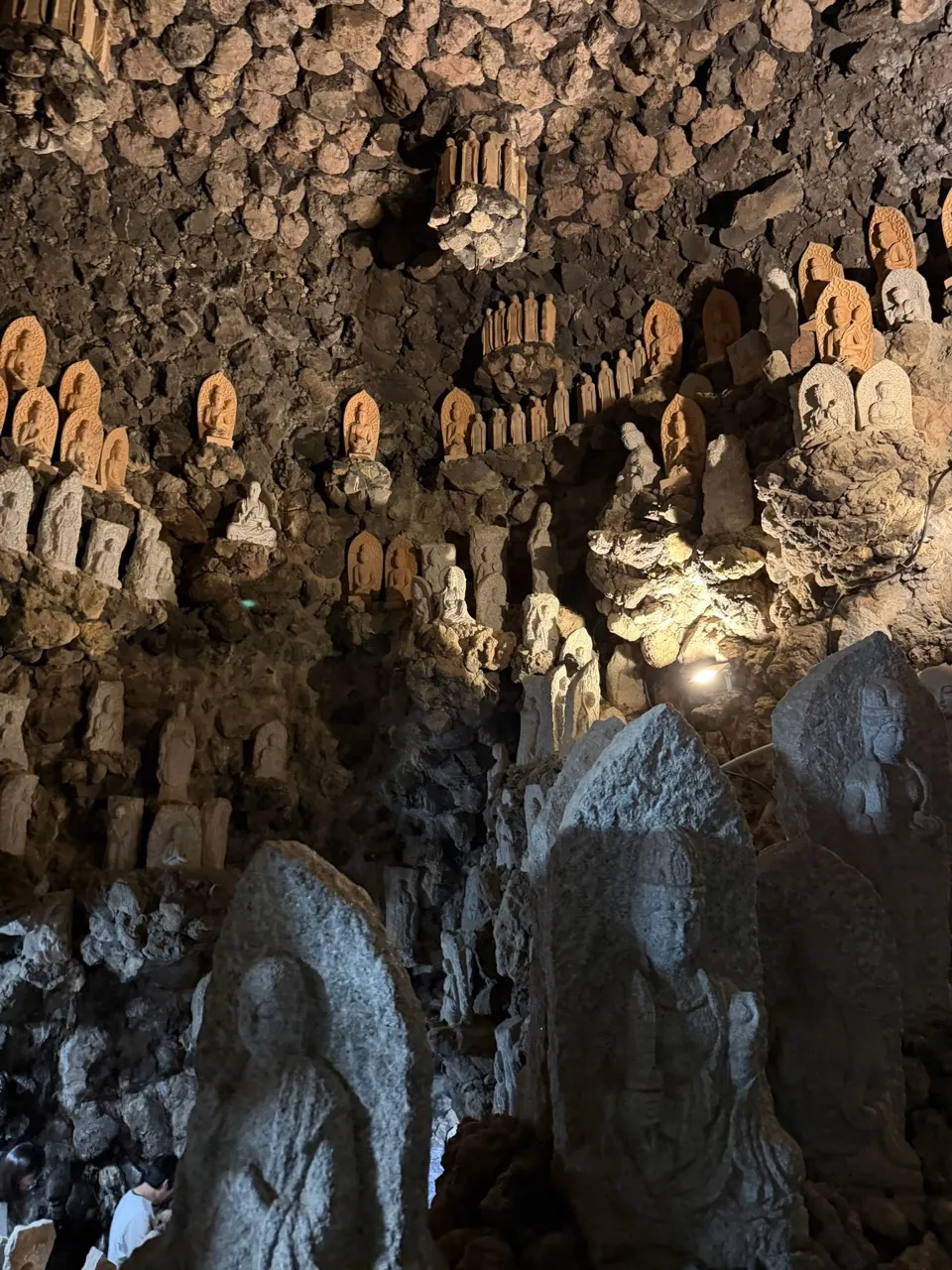 Inside Kōsanji’s grotto.
We ended the day driving up to Kirosan Observatory Park, a steep, windy uphill road that pays off with sweeping views of the islands and the bridges, including the climax of the whole route, the Kurushima-Kaikyō Bridge: a nearly four-kilometer triple suspension bridge, the only one of its kind in the world, threading between green islands and tidal channels.
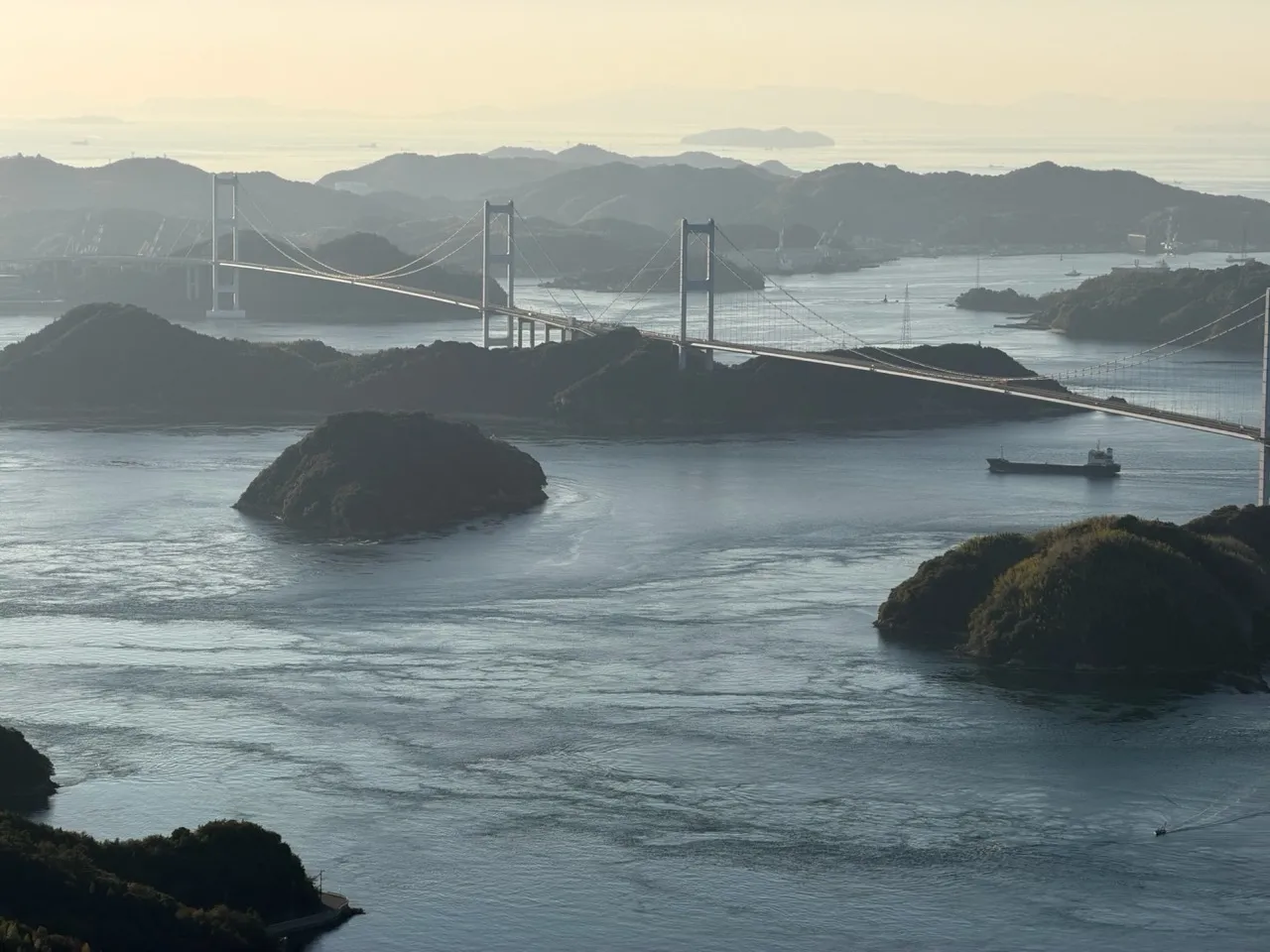 The Kurushima-Kaikyō Bridge from Kirosan, where Honshu’s island chain finally reaches Shikoku.
Imabari: sushi, and a silent castle
We stayed the night at the Imabari Kokusai Hotel, nice, good view. For dinner we drove about 20 minutes into town to a Sushiro, and we were the only Americans there, there’s no convenient train out to Imabari, so tourists basically don’t come. It was packed with locals, and we were so happy, plates of conveyor-belt sushi like always.
We ended the night walking the grounds of Imabari Castle. It was closed for the night, of course, so we couldn’t go inside, but lit up in the dark it was a completely different atmosphere from anything we’d felt before. There was not a single soul outside. No strangers, nobody walking, nothing, completely silent, completely still. Eerie and beautiful.
The next morning’s hotel breakfast was a buffet with one detail Nick loves to point out: Japan has its own oranges, called mikan, small, sweet mandarins, and this being Ehime Prefecture, which is the mikan capital of Japan, the buffet had fresh mikan juice on tap. It was delicious, and we had way too much of it.
Across Shikoku to the whirlpools: Naruto
From there we drove our rental car all the way across Shikoku to Naruto, where our hotel was for one night. The draw here is the Naruto whirlpools in the strait beneath the Ōnaruto Bridge.
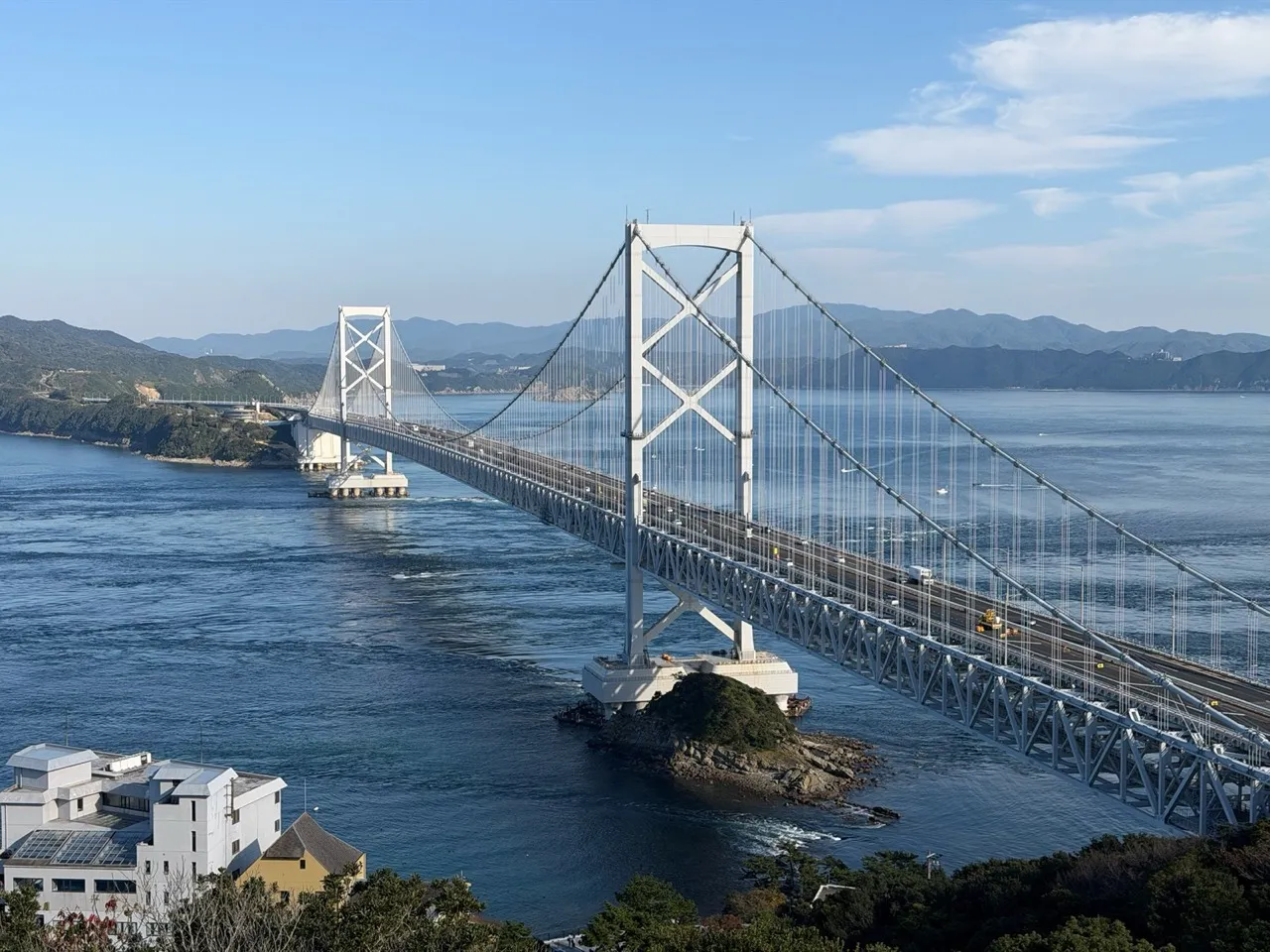 The Ōnaruto Bridge over the Naruto Strait, famous for the tidal whirlpools that churn beneath it.
We rode the big escalators up to the top lookout and saw the whirlpools swirling below, we didn’t do a boat tour out to them, partly because by now I was starting to feel sick: sore throat, my nose hurting, the unmistakable onset. We’d had bigger plans, but we did what we could, saw the whirlpools, and went back to the hotel, which was pretty basic and unremarkable. I’d wanted to get out on the beach, but I just wasn’t feeling well enough, so I tried to conserve energy instead.
Himeji, and Nick’s last castle
The next day we drove to Himeji and explored Himeji Castle, the brilliant-white “White Heron,” the finest surviving original castle in Japan and one of its first UNESCO World Heritage sites. We grabbed McDonald’s at the station first, then went into the castle complex.
It’s where Nick hit his limit with one specific thing: too many people in too tight a space. And the timing didn’t help, right around then, news broke that a fire had destroyed a wooden pavilion at the Yongqing Temple in China (it burned on November 12, 2025, reportedly from a visitor’s candle rather than the lightning I’d half-assumed). Standing inside a packed, centuries-old wooden castle, Nick couldn’t stop thinking: if this caught fire, with this many people and these tight, slow stairways, we’d be in real trouble. He decided he’s probably done with castles after this. And that’s fine, you live and you learn.
Returning the car got complicated. We were on a tight Shinkansen timeline and I couldn’t figure out the gas situation, so I returned it without refilling, and, worse, I accidentally left my International Driving Permit in the glove box. We called later, but they had no way to get it back to us, so we just asked them to destroy it. A small, dumb loss at the end of a bucket-list drive.
Sick in Hikone
We took the Shinkansen to Hikone, hoping to see its famous original castle, and never even got to it. By then I was pretty sick, and Nick was going down too. We stayed in a big, cool Airbnb, but mostly we just were sick. I ventured out once in the middle of the night for fluids and snacks. We’d meant to explore in the morning, but neither of us could find the energy, so we rested instead, which turned out to be the right call, because next up was a place we really wanted to see properly.
Odawara, and the climb into Hakone
Feeling a little better, we rode the Shinkansen to Odawara Station, where we did one of our happy rituals, Burger King, which we love getting in Japan, and visited Odawara Castle, wandering the grounds. I’d really hoped to reach the coast here; seeing Japan’s black volcanic-sand beaches was actually a big reason we stopped. But we still weren’t 100%, so we conserved energy and saved it for another time.
Then we caught the special train you have to take up into Hakone, the Hakone Tozan Railway, one of the oldest mountain railways in Japan. It climbs steep grades by switchbacks, where the train stops and reverses direction to zig-zag up the mountainside, gaining serious elevation the whole way. It’s a slow, wonderful, engineering-marvel of a ride.
Hakone: onsen, a Michelin Key, and a black egg we didn’t dare
We stayed at Hakone Gora Karaku in Gora, genuinely luxurious, a Michelin Key property, with our own private onsen in the room and a view full of fall leaves. Its dining room, Mutsuki, served a multi-course kaiseki dinner that was completely out of our usual league, a beautiful five-course experience we got to have for three nights. The first night we just chilled and soaked it all in.
One Hakone memory I love: Nick wanted a nap, and I wanted snacks, so I walked down this enormous mountain and across the river to a 7-Eleven. On Google Maps it looks close; what the map doesn’t tell you is the massive elevation change between you and it. I made it down and back without any trouble, and I came home with snacks, including my trip ritual: I like to eat ice cream everywhere I travel, and my favorite there is Chocomonaka (the chocolate wafer-monaka ice cream sandwich). I bought a few to stash in the fridge so I’d have one for each night.
On our second Hakone day we did the ropeway to Owakudani, the steaming, sulfur-venting volcanic valley.
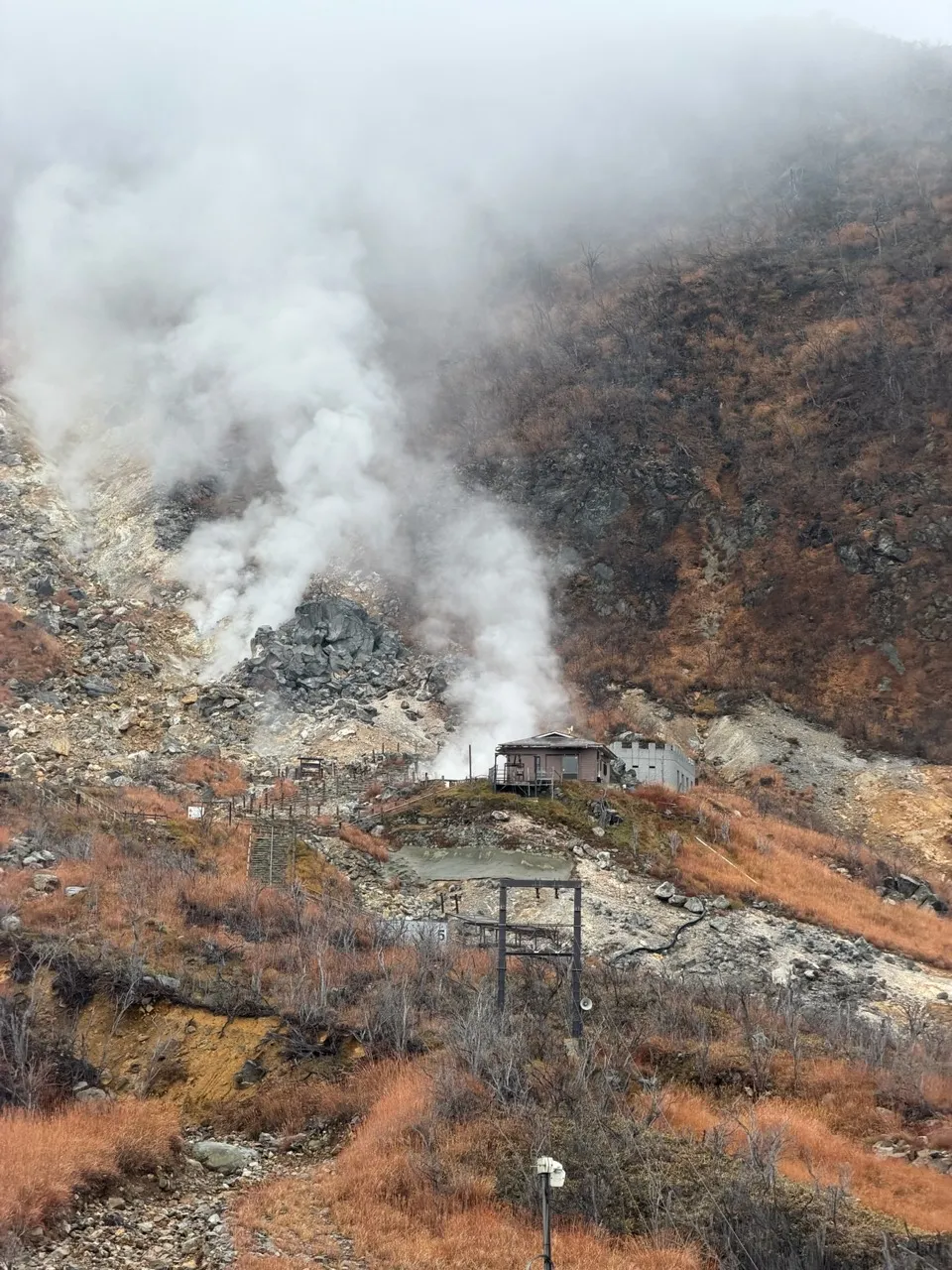 Owakudani’s steaming vents, seen from the Hakone Ropeway.
This is where they boil the famous kuro-tamago, black eggs cooked in the hot springs until their shells turn black, said to add seven years to your life. We got some black-egg-themed bits, but we weren’t brave enough to actually eat one. It was too foggy to see Mount Fuji from up there, sadly, but the steam-vent fields were otherworldly. We rode the ropeway down to the port and took the wonderful pirate ship across Lake Ashi to Moto-Hakone, where we had a fantastic lunch at Fuki (富貴), I’m pretty sure it was curry rice and a pork katsu cutlet, and it was so good. Then we explored the lakeside Hakone Shrine and took the bus back. The weather wasn’t its best, not raining exactly, just wet, damp, drizzly, but we made the most of it.
Last nights: back to Tokyo
Finally we headed back to Tokyo, where we’d loved staying at the Hotel Blossom Hibiya enough to book it for our last two nights. We took it easy, explored on our own whims, almost certainly ate more sushi, drifted through a couple of places. It was the end of a long, ambitious trip, and we just did whatever we wanted. Then the long flight home.
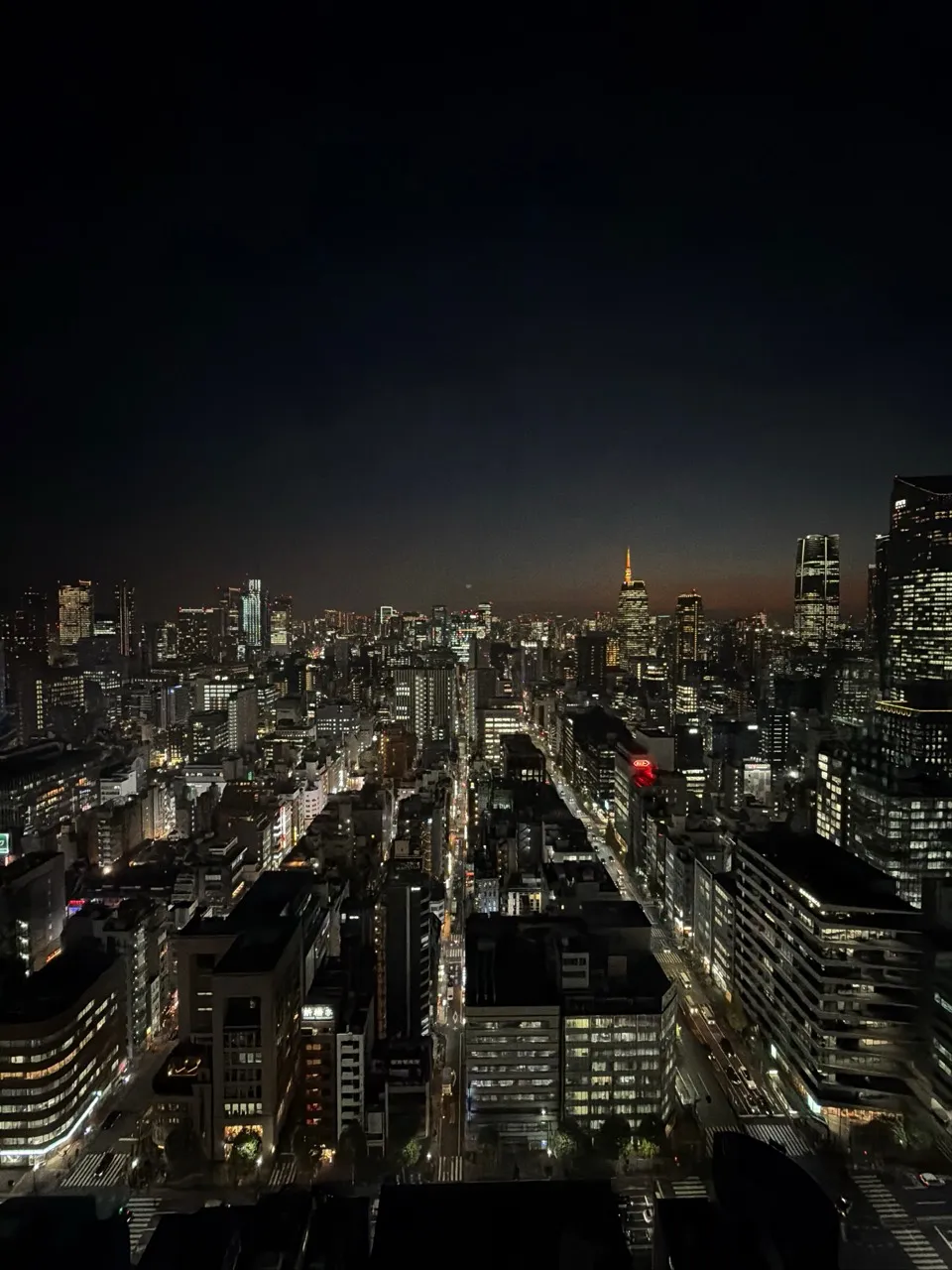 Tokyo at night, Tokyo Tower burning orange on the horizon.
Trip One vs. Trip Two
The map tells it: Trip One was Tokyo, Kamakura, Kyoto, Nara, temples and neon and a first-timer’s overwhelm. Trip Two ran the length of the country’s nature instead, Nikko’s foliage, a clean Fuji, Miyajima’s floating gate, a self-driven island-hopping route across the Inland Sea, a white castle, a whirlpool strait, and a steaming volcanic valley, and it asked more of us, right down to driving on the other side of the road and pushing through getting sick on the road. I’m lucky to have seen both Japans. I’m still deciding which one I am, and I suspect the honest answer is both, which is exactly why I’ll keep going back.