For Grandpa Czar
A page I am starting for my dad's father, Czar Harley Hertzelle (1919 to 1990). He died when I was a baby, so I am building this one out of a photo, a 1940 draft card, and the stories my dad still carries.
This is the hard one to write, because I have to be honest: I do not remember my grandfather. Not really. He died on January 23, 1990, when I was not even two years old, and whatever a baby holds onto, it was not enough to keep him. I have felt strange about admitting that, but it is just the truth, and pretending otherwise would not honor him. So instead I am going to do the next best thing. I am going to build this page out of the pieces I can find, and out of the stories my dad and my aunt Cheryl still carry, and try to know him a little, backward, after the fact.
I am starting this now, and I already know it is not finished. I want to sit down with my dad and really ask him about his father, the way you only think to do once it might be getting late to ask. When I do, I will come back and fill this in. Consider this the beginning.
The one photo I have of us
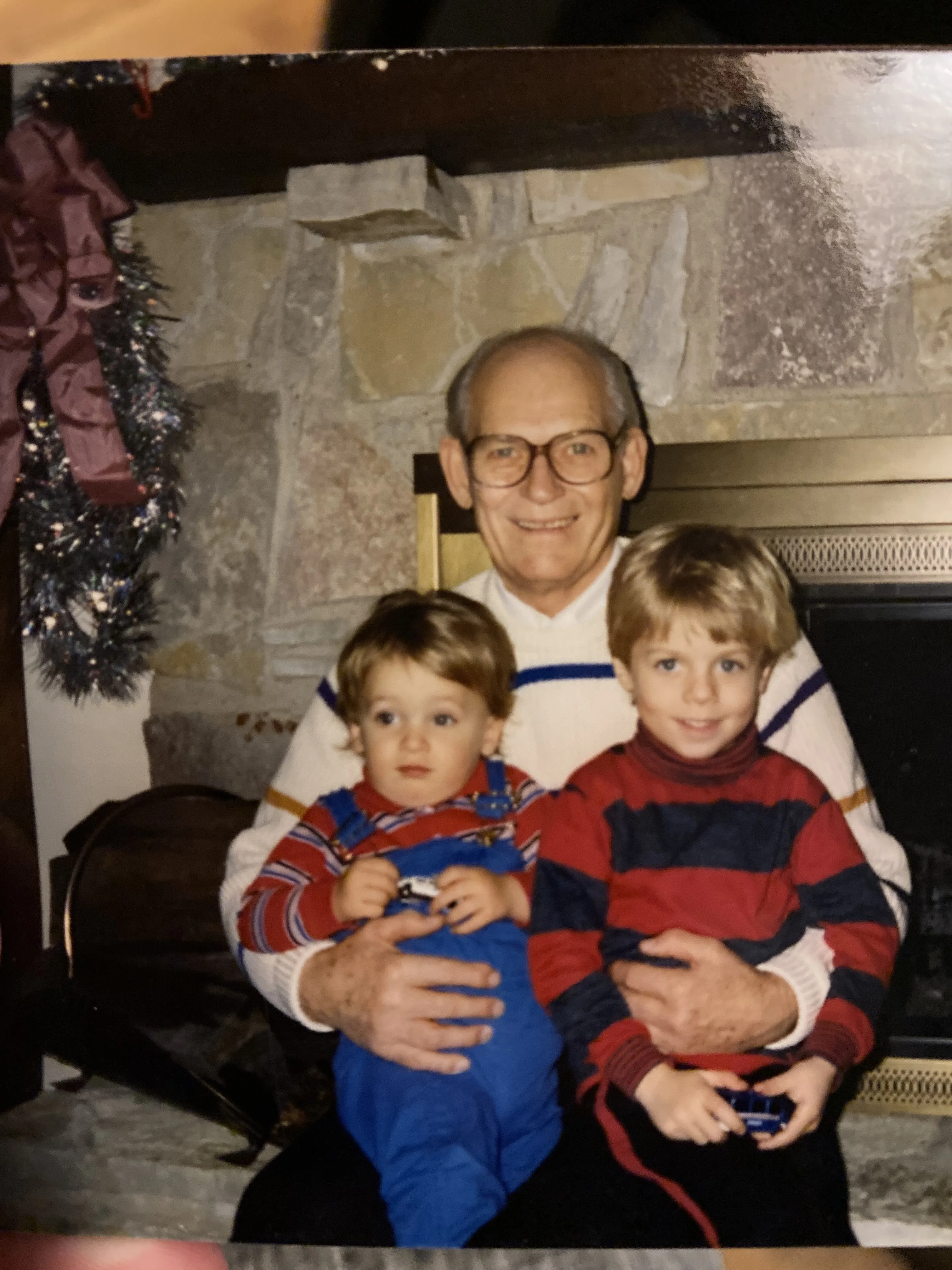
Here is what I do have. It is Christmas, and there he is by the fireplace, glasses on, in a striped sweater, with two little boys on his lap. The toddler in the overalls is me. The older boy is my brother. If I had to guess, we are at my aunt Cheryl’s house, which means he and my grandma must have come down to St. Louis for the holiday. I can see tinsel and a wreath behind us, so I know the season even if I cannot remember the day.
He died that January, so this was one of the last Christmases of his life, maybe even the last. Whatever was happening in that picture, I was too young to keep it. But the picture kept it for me, and now I get to look at the proof that he held me at least once.
What the records tell me
Czar Harley Hertzelle was born on October 16, 1919, in Calvin, up in Cavalier County, North Dakota. (Yes, his name was Czar. I love that.) His parents were Michael and Mary Hertzelle, and he came from a big North Dakota family, one of several brothers: Farrell, Austin, Owen, and more.
In 1941 he married my grandma, Idyll Lucille Sannes, and they settled in Grand Forks and raised three kids: my uncle Roger, my aunt Cheryl, and my dad, Marlin. He lived to be seventy years old, and he is buried in Park River, North Dakota, the same little town where my grandma was laid to rest eight years later. You can read her memorial here.
His draft card
Here is the document I really wanted to include. This is his draft card, filled out on October 16, 1940, which I just realized is his twenty-first birthday. He registered with the local Selective Service board in Langdon, North Dakota, on the very day he came of age for it.
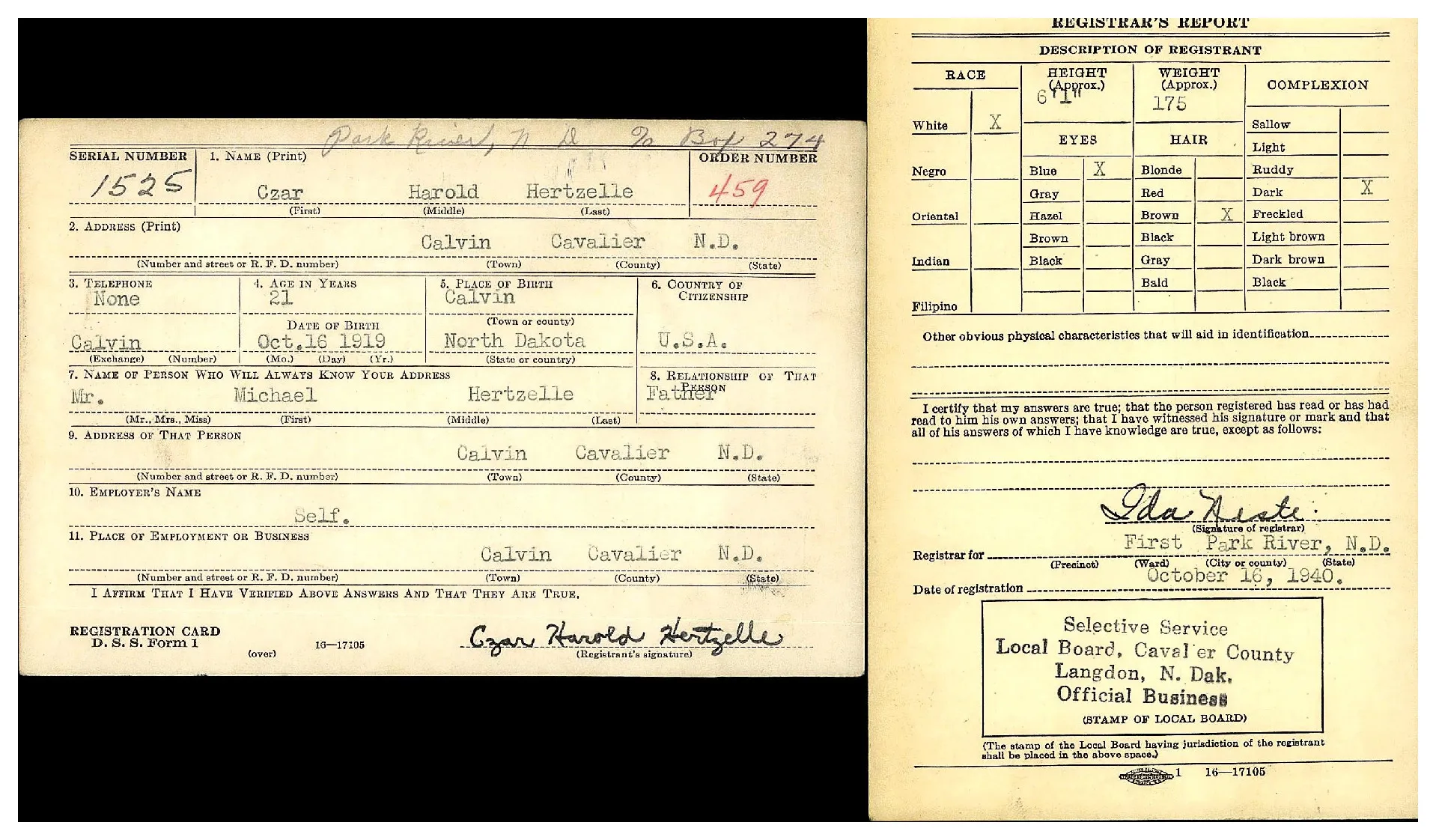
I love how much of a person shows up on a form like this. He was twenty-one, living in Calvin, with no telephone. The line for an employer just says “Self.” The registrar measured him at six foot one and 175 pounds, with gray eyes and dark hair. And down at the bottom, in his own hand, he signed it: Czar Harold Hertzelle. The family spells the middle name Harley, but the young man signing this card wrote Harold, and I am not going to be the one to correct him.
My understanding is that he went on to serve in World War II, and there is a Veterans Affairs record on him that points the same way. The full story of his service is one of the first things I want to ask my dad about, so I can tell it right rather than guess at it.
The ice cream truck
The one story that has always stuck with me, the one my dad used to tell, is that at some point Grandpa Czar drove an ice cream truck. My dad remembered it fondly for exactly the reason you would expect from a kid: it meant he, and his friends, had a direct line to ice cream. That is the whole image I have of my grandfather as a younger man. A guy driving the ice cream truck, making himself the most popular dad on the block without even trying.
Now I know how he ended up there. He came home from the war without much waiting for him, so for a while he cleaned carpets, until he had had enough of it. Then he caught on with Bridgeman, a creamery: a real Upper-Midwest dairy that ran milk and butter and ice cream routes all across Minnesota and North Dakota. They offered him a desk job in the office, and he turned it down flat. He did not want to sit still, he wanted to be out moving all day, so he took a delivery route instead. That is the whole secret of the ice cream truck: a restless man handed the keys to exactly the right job.
The kind of man he was
When he finally retired from the route, he could not quite sit still even then, so he took a part-time job at a funeral home, and the people there thought the world of him. He was careful and detail-minded, the kind of man who could always find money. He was a deacon at his church. He bowled on a team. And for a man of his time and place he had one funny gap: he never fished and never hunted, just was not interested, while it seemed like every other man around him was.
Above all of it, he was a family man, and family was the thing that mattered to him most. The simplest and truest thing I can say about him is three words: he was a good man.
There is one more piece, and it is the one that stops me. He was social and kind and forever taking notes, writing things down, keeping track of who had passed and when. I am building this whole page out of secondhand memories, writing down a man I never got to know, and it turns out that is the most him thing I could possibly be doing. I would like to think he would recognize it.
This is far more than I had a week ago, and still not the whole of him. But he deserves more than a blank space, and this is a real start. Grandpa, I am sorry I do not remember you. I am going to spend some time learning who you were, and I will write it down here, so that I do.